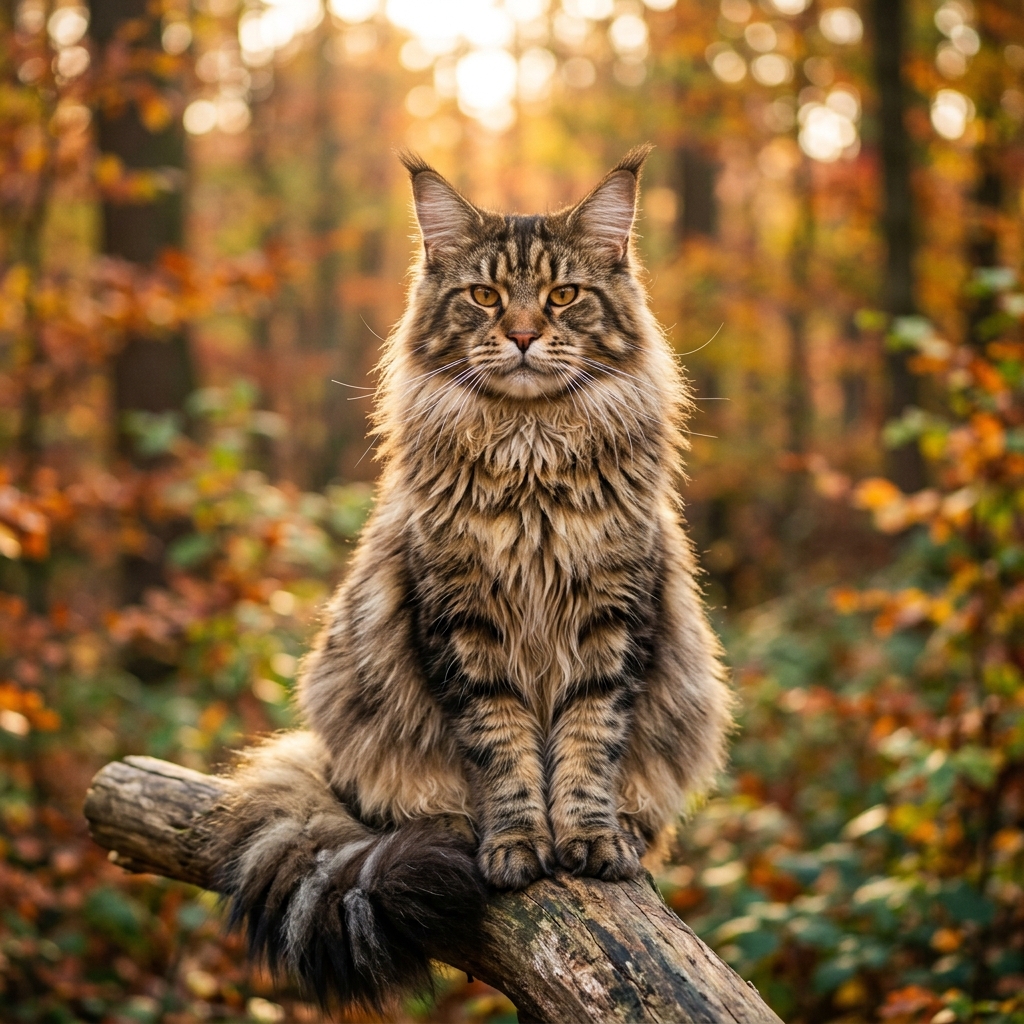
The Maine Coon is easily one of the most impressive cats on the planet. Often called "gentle giants," these massive felines don't follow the rules of normal cat growth. While your average tabby is fully grown by age one, a Maine Coon is just getting warmed up.
If you've just brought home one of these tiny (for now) lions, you're probably staring at those huge paws and wondering when the rest of the cat will catch up. We're going to walk through the Maine Coon growth chart, covering those vital milestones from 8 weeks all the way to year five. Knowing what's normal will help you keep your giant healthy and happy while they take their sweet time growing up.
Why "Slow-Growth" Is a Big Deal
The most striking thing about Maine Coon development? Its sheer length. Most cats are "done" by their first birthday, but a Maine Coon is really just hitting its stride. These guys continue to build muscle, bone density, and that famous shaggy coat for three to five years.
Think of it as a biological long game. Because they carry such massive frames, their bones and joints need that extra time to harden and support the weight. If you're a Maine Coon parent, this means your "little" kitten might actually need kitten-specific calories well past their first birthday.
Maine Coon Growth Chart: Weight by Age
Weight is the yardstick most owners live by, but don't obsess over every ounce. Genetics and diet play a huge part, and there's a massive gap between the sexes -- males are almost always significantly beefier than females. This breed is widely considered one of the 8 Biggest Domestic Cat Breeds in existence.
| Age | Male Weight Range | Female Weight Range |
|---|---|---|
| 8 Weeks | 2.0 - 3.5 lbs (0.9 - 1.6 kg) | 1.5 - 2.5 lbs (0.7 - 1.1 kg) |
| 3 Months | 4.0 - 6.0 lbs (1.8 - 2.7 kg) | 3.0 - 5.0 lbs (1.4 - 2.3 kg) |
| 6 Months | 8.0 - 12.0 lbs (3.6 - 5.4 kg) | 6.0 - 9.0 lbs (2.7 - 4.1 kg) |
| 9 Months | 12.0 - 16.0 lbs (5.4 - 7.2 kg) | 8.0 - 11.0 lbs (3.6 - 5.0 kg) |
| 1 Year | 13.0 - 18.0 lbs (5.9 - 8.1 kg) | 9.0 - 12.0 lbs (4.1 - 5.4 kg) |
| 2 Years | 15.0 - 22.0 lbs (6.8 - 10.0 kg) | 10.0 - 14.0 lbs (4.5 - 6.4 kg) |
| 3-5 Years (Full Adult) | 18.0 - 25.0+ lbs (8.1 - 11.3 kg) | 12.0 - 18.0 lbs (5.4 - 8.1 kg) |
Beyond the Scale: How Big Do They Get?
Weight doesn't tell the whole story. To get a real sense of these cats, you have to look at their dimensions. There's a reason Maine Coons dominate the Guinness World Records for length.
- Length: A typical adult measures 30 to 40 inches from their nose to the base of their tail. Some absolute units even cross the 48-inch mark.
- Height: You're looking at 10 to 16 inches tall at the shoulder.
- The Juvenile Phase: Because their metabolism and bone structure take so long to settle, your Maine Coon is nutritionally a "kitten" until they're at least 15 or 18 months old.
Stage 1: The Exponential Phase (0-9 Months)
Expect a total whirlwind for the first nine months. Your kitten will be putting on about one to two pounds every single month. This is the frame-building stage. Owners often compare them to other large shaggy breeds, as noted in our Norwegian Forest Cat vs. Maine Coon breakdown.
Don't be surprised if your kitten looks a bit ridiculous during this time. We call it the "gangly phase" -- long legs, massive ears they haven't grown into yet, and a skinny body. Like a human teenager, they're shooting up in height before they fill out. Load them up on high-quality proteins and fats now; they need the fuel.
Stage 2: The Developmental Plateau (9 Months - 2 Years)
This is the part that usually freaks owners out. Around the 9-month mark, that skyrocketing growth often just... stops. You might see the scale stay exactly the same for months.
Relax. They haven't stopped growing; they're just consolidating. Instead of growing "up," they're growing "out." Their internal organs are maturing and their skeleton is hardening. Resist the urge to overfeed them to force the scale to move -- you want lean muscle, not a fat cat.
Stage 3: The Filling-Out Phase (3-5 Years)
This is the home stretch. Between years three and five, your Maine Coon finally transforms into the "lion" of the cat world. This Maine Coon Guide explains more about their specific physical traits.
- Muscle Mass: The chest broadens and the shoulders get heavy and powerful.
- The Coat: That iconic neck ruff (the "mane") finally hits full density.
- Facial Structure: The muzzle squares off and becomes more prominent.
- Weight: It's common for males to pack on their final 5 pounds of solid muscle during these last two years.
What Actually Determines Their Size?
Your cat's final size isn't just luck. A few big factors are at play:
Genetic Heritage
Lineage is everything. "European" lines often look more feral with huge muzzles and tall ear tufts. "American" lines are sometimes a bit softer but just as massive. If you want a guess at your kitten's future, look at the parents (the sire and dam).
The Spay/Neuter Effect
When you fix your cat matters. Research shows that neutering early (before 6 months) often results in a slightly taller cat. Without sex hormones to signal the growth plates to close, the bones just keep lengthening. However, these "early" cats might not develop the same thick muscle heft as those fixed a bit later.
Specialized Nutrition
Since they're growing for five years, their nutritional needs are specific. Large-breed or kitten-specific formulas are usually recommended for at least the first 15 months to ensure they get enough calcium, phosphorus, and taurine for their big hearts and heavy bones.
Health and Your Giant Cat
Being huge carries risks. Obesity is the absolute worst thing for a growing Maine Coon. A 25-pound cat is amazing, but it needs to be 25 pounds of muscle, not 25 pounds of kibble-belly.
Because of their size, they are prone to Hip Dysplasia -- where the joint doesn't sit quite right. Keeping them lean during that 5-year growth window is the best way to protect their joints. Also, keep an eye out for Hypertrophic Cardiomyopathy (HCM). It's a common heart issue in the breed, and that big body puts a lot of demand on the cardiac muscle. Regular vet checks are a non-negotiable.
Raising a Maine Coon is a marathon, not a sprint. If you can handle the "gangly" phases and the weight plateaus, you'll be rewarded with a majestic, lion-maned companion that was well worth the wait.
- Trust the Plateau: If your teen cat isn't gaining weight but is still zooming around the house, they're fine.
- Feel the Ribs: You should always be able to feel their ribs under a thin layer of skin. Muscle is the goal; fat is the enemy.
- Think Big: Get the XL litter boxes and the heavy-duty scratching posts now. They're going to need them.
- Protein is King: Quality animal protein is the fuel for that five-year journey.
Just enjoy the ride. Before you know it, those oversized paws will belong to a cat that looks like it stepped out of a fairytale.
Medical Disclaimer: This info is for educational purposes and isn't a replacement for a real vet. If you're worried about your cat's health, go see a professional.