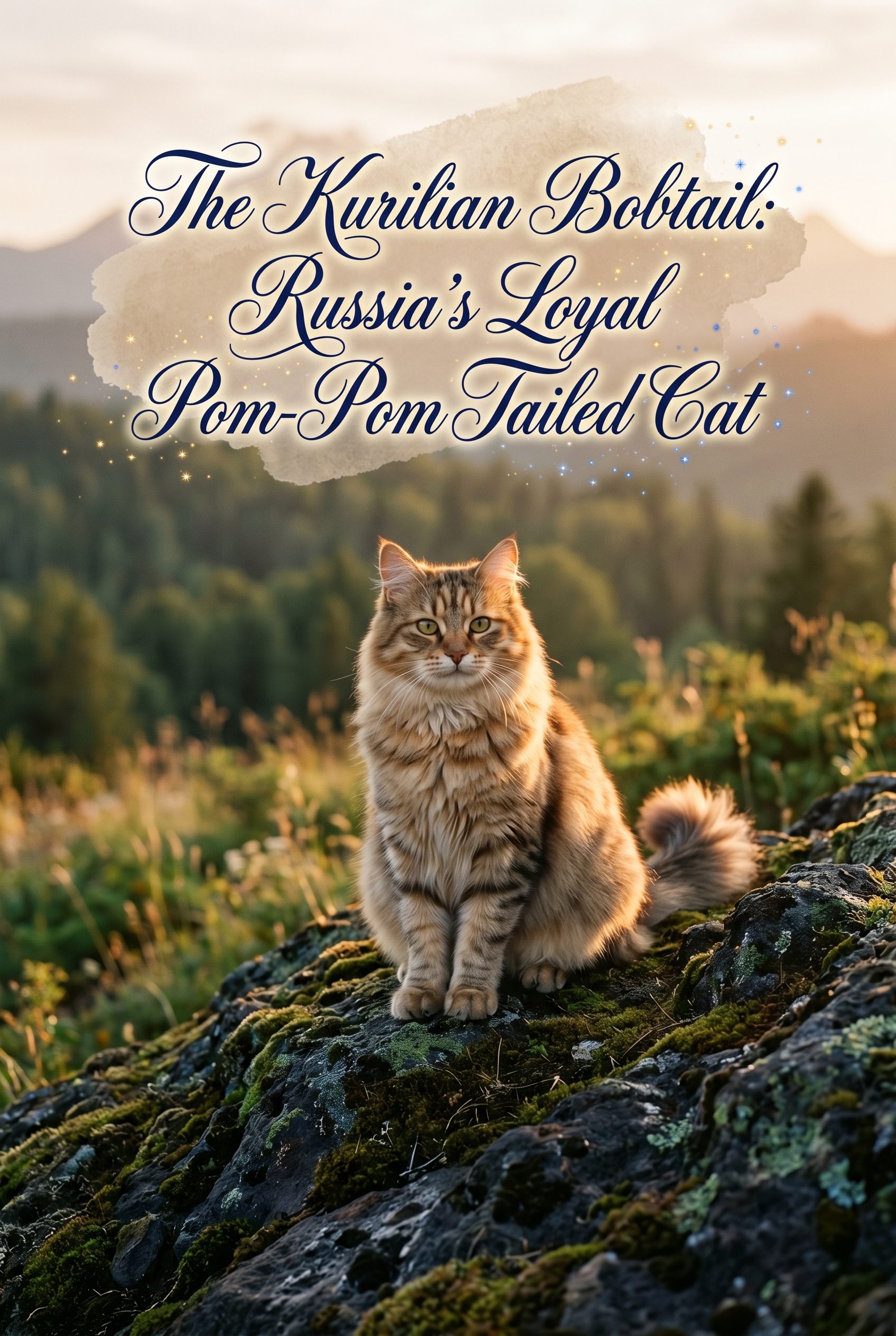
Straight from the volcanic ridges of Russia's Kuril Islands, the Kurilian Bobtail is a rare "natural" breed that feels like a piece of the wild living in your living room. Best known for their unmistakable "pom-pom" tails, these cats offer way more than just a quirky silhouette. They are famous for being fiercely loyal, incredibly smart, and possessing a dog-like devotion that's hard to find in the feline world. If you're looking for a sturdy, playful companion that will stick by your side for up to 20 years, you've met your match.
History and Origin The Kurilian Bobtail isn't your average designer pet; its story began in the rugged, windswept landscapes of the Russian Far East. This is a natural breed, meaning nature -- not humans -- did the heavy lifting on the Kuril and Sakhalin Islands. According to TICA, cats with short tails have been documented on the Kuril and Sakhalin Islands for at least 200 years, and members of the Russian military or scientists brought them back to the Russian mainland in the middle of the 20th century.
The breed has since been formalized by the major registries. According to FIFe's breed page, the registry has recognized the Kurilean Bobtail since 2004, and TICA accepted the breed to Championship status in 2012. FIFe treats it as a Russian aboriginal breed that is separate and distinct from the Japanese Bobtail, despite the visual similarities. Once prized by islanders as elite hunters, they have traded the volcanic islands for living rooms worldwide, bringing that same hearty mountain spirit with them.
Physical Characteristics: The Pom-Pom Tail Pick one up, and you'll notice they are solid. These are strong, semi-cobby cats with a substantial build. According to TICA's breed profile, mature males can weigh as much as 15 pounds, while females are generally smaller at 8 to 11 pounds.
But let's talk about the main event: that tail. TICA describes the short, bushy tail as consisting of anywhere between 2 and 10 vertebrae, kinked many times in various directions -- shaped like a whisk, a spiral, or a snag. Every tail is a unique fingerprint; no two are exactly alike. They come in both shorthaired and longhaired varieties and almost every color under the sun, with FIFe permitting all traditional colors except color-point, chocolate, cinnamon, fawn, and lilac.
Temperament and Personality If you want a "dog in a cat suit," you've found it. Kurilian Bobtails form intense, devoted bonds with their humans. They aren't just roommates; they are shadows. Much like the American Bobtail Cat, they are renowned for their loyalty. Since they are a highly intelligent cat breed, a bored Kurilian is a creative Kurilian (and you might not like what they create). They thrive on puzzle toys, and TICA notes they can be trained with a single demonstration and are considered "the clowns of the cat world."
Similar to the Japanese Bobtail, they are surprisingly quiet, preferring to show their affection through presence rather than constant meowing. They are legendary for being patient "nanny" cats with children and other pets -- TICA specifically lists the breed as adapting well to other cats, dogs, and household children. The flip side of that easy adaptation is what makes them interesting: they have a lot of opinions, and they expect you to listen.
Care and Grooming Requirements You'd look at that lush coat and think you're in for a grooming nightmare, but it's actually pretty low-maintenance. TICA describes the coat as soft, silky, and generally non-matting; a once-a-week brushing is usually plenty. What they really need, though, is a workout. These are active explorers who love to climb and survey their domain from the highest perch available -- think cat trees, secure catios, and lots of interactive play.
Keep their brains busy by rotating their toys -- they're too smart to play with the same plastic mouse for three months straight.
Health and Lifespan
Because they developed in the wild without human tinkering, Kurilian Bobtails are remarkably hardy. TICA's breed profile describes Kurilians as "generally a hearty, natural breed" with "not many known health issues," and the breed's wide, naturally diverse gene pool has so far kept inherited disorders at bay.
That reassuring summary is not a substitute for screening an individual cat. TICA's profile does not name a Kurilian-specific health screening panel, so prospective owners should ask which orthopedic and cardiac examinations or DNA tests, if any, were performed on the parents, request the results, and discuss appropriate baseline exams for the individual cat with their veterinarian. Do not treat a broad DNA panel as automatic reassurance: the University of Missouri's Feline Genetics and Comparative Medicine Laboratory cautions that a genetic test is valid only for breeds in which the variant was discovered and supported by published information. Its table lists an HES7 test for the bobbed-tail trait in Japanese and Kurilian Bobtails; it does not present that trait test as a Kurilian disease screen.
TICA lists the typical lifespan as 15 to 20 years, though individual longevity varies with diet, preventive care, environment, and genetics, as it does in any breed. As with any cat, the basics matter most: regular vet visits, high-quality nutrition, and weight management so that muscular frame stays agile through the senior years.
Behavior and Welfare: A Practitioner's Perspective In my behavior practice, the traits that make a breed shine in a profile are usually the same traits that show up in the exam room when those needs go unmet. The Kurilian's intense social attachment, problem-solving drive, and trainability are precisely what people fall in love with -- and they are also what produces behavior problems when a household is not set up to support them. A few patterns are worth flagging for prospective owners. I use breed traits to guide questions about routine, social contact, and enrichment, not to diagnose an individual cat; the observations below are clinical impressions rather than evidence that Kurilians have higher rates of any specific behavior disorder:
- Bonded cats can struggle with solitude. A cat that follows you from room to room is appealing until the workday stretches to ten hours. In my clinical experience, separation-related vocalization, house-soiling, or destructive behavior are signs to investigate, not proof that an attached Kurilian has a breed-specific disorder. Kurilian-specific prevalence data are not established here; in a 2020 peer-reviewed questionnaire study of 223 cats, 30 met at least one of the study's criteria for separation-related problems, with destructive behavior, excessive vocalization, and inappropriate urination among the signs reported. Households that are empty for long stretches should plan for a companion animal, a midday pet sitter, or a serious enrichment setup before they bring one home.
- High intelligence cuts both ways. A Kurilian that learns the rules once will also learn the inconsistencies. Mixed messages do not produce a more obedient cat; they produce a cat that has decided your corrections are arbitrary and stops engaging. Pick your boundaries and hold them.
- "Quiet" is not the same as "low-maintenance." The breed's soft trill is real, but so is the need for vertical territory, daily interactive play, and rotating puzzle feeders. Without these, behavior problems are predictable rather than merely possible.
None of this is a reason to avoid the breed. It is the case for choosing it honestly.
Is This Breed Right for You?
The Kurilian Bobtail is a strong match for households that want an interactive, present companion and are prepared to provide one. They are not decorative sofa ornaments; they want to be part of the action. A household with another cat-friendly pet, predictable routines, and someone home for a meaningful part of the day will get the best of this breed. Households that are quiet for long hours, or that want a hands-off pet, will likely find the same traits frustrating rather than charming.
If you are looking for a loyal, playful friend who will actually greet you at the door, this Russian breed is hard to beat -- provided you have the energy, time, and structure to keep up with them.