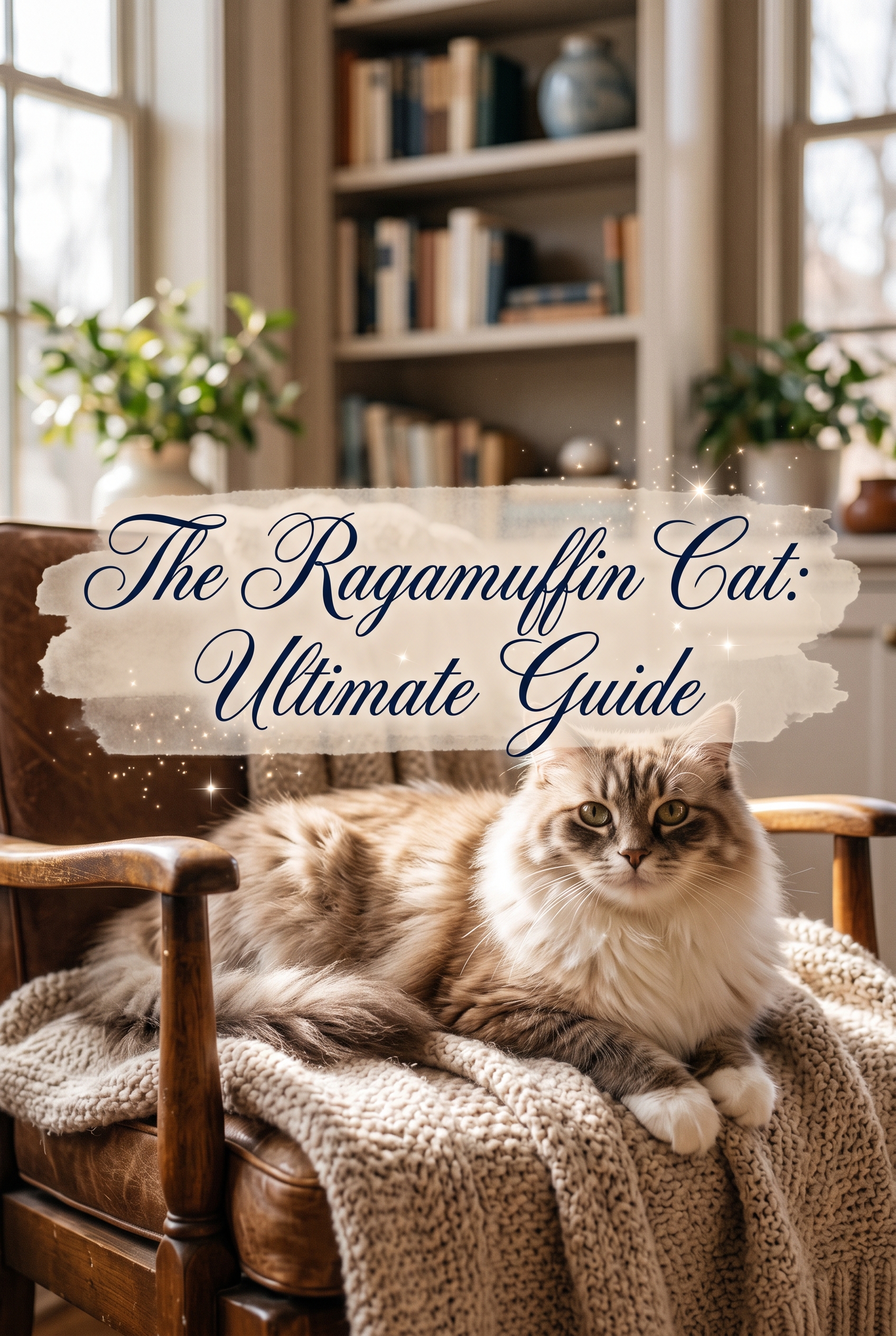
Think of a cat that's part teddy bear, part loyal puppy, and entirely soft. That's the Ragamuffin. This isn't just a cat that lives in your house; it's a "gentle giant" that lives for your attention. Born from the Ragdoll lineage, these big, fluffy felines are famous for one thing: being the ultimate lap warmer. If you're after a dog-like loyalty in a cat that feels like a cloud, you've found your match.
The Ragamuffin — Meeting the World's Most Cuddly Gentle Giant
The Ragamuffin is a large, semi-longhaired breed best known for one thing: an extraordinarily docile, "puppy-like" temperament that has earned it a reputation as the cuddliest cat in the world. Closely related to the Ragdoll (and sharing ancestry with it), the Ragamuffin was developed by breeders seeking a broader genetic base and a wider color range than the Ragdoll allowed. The result is a gentle giant cat that often goes limp when held, follows its humans from room to room, and prefers physical contact over almost everything else.
"Ragamuffins are made for households that want a big, calm, snuggly cat. They're not athletic jumpers and they don't have an ounce of hunter in them. They're couch companions with the build of small dogs." — Dr. Sarah Mitchell, DVM
Origin and History
The Ragamuffin shares recent history with the Ragdoll: both descend from Josephine, a white Angora-type cat owned by Ann Baker in Riverside, California, in the 1960s. Ann Baker developed the Ragdoll breed from Josephine's offspring, then tightened control over the breed by requiring breeders to license cats through her organization and pay royalties.
In 1994, a group of IRCA Ragdoll breeders — upset by Ann Baker's restrictions and the requirement to use only Baker-approved stock — broke away (Wikipedia, 2026). They bred their cats to Persians, Himalayans, and other longhaired breeds to widen the gene pool, then formalized the new breed as the Ragamuffin. The name is a play on "ragged" — referencing the breed's classic floppy cuddle behavior — and "muffin," a nod to the cat's round, muffin-like face.
The Ragamuffin was recognized by:
- ACFA in the 1990s (early adopter)
- CFA in 2003 (registration) / 2011 (championship status) — CFA breed profile
- TICA, GCCF, and other registries
Physical Characteristics
| Trait | Description |
|---|---|
| Coat | Semi-long, plush, rabbit-like texture |
| Body | Large, rectangular, heavy-boned ("substantial") |
| Weight | 10–20 lb (males much larger) |
| Eye color | Any color, including odd-eyed in CFA |
| Head | Broad modified wedge with walnut-shaped eyes |
| Lifespan | 12–17 years |
The coat is the breed's signature: it's medium-long but has a unique sheen and texture that feels like rabbit fur. Ragamuffins are slow to mature and may take up to four years to reach full coat and body weight, with mature males reaching up to 20 lb and females closer to 15 lb (CFA breed profile).
Coat Colors
Unlike the Ragdoll (which is restricted to pointed colors and certain patterns), the Ragamuffin comes in any genetically possible coat color and pattern — though CFA and GCCF disqualify pointed cats from show classes (CFA breed profile):
- Solid (black, blue, red, cream, white, chocolate, lilac, cinnamon, fawn)
- Tortie and torbie
- Tabby (classic, mackerel, spotted, ticked)
- Bicolor and tricolor
- Mink (aqua eyes) and sepia (yellow/gold to green eyes)
- Smoke and shaded
This is one of the breed's distinguishing features from the Ragdoll.
Temperament — The Defining Trait
The Ragamuffin's personality is so distinctive that breeders consistently describe it in similar terms:
- Going limp when held: Many Ragamuffins go fully relaxed when picked up, similar to Ragdolls.
- Cuddle-seeking: They actively seek physical contact — sitting on laps, leaning against owners, sleeping on or under covers.
- Low activity level: They prefer slow play and warm laps over high-energy games.
- Sociable with strangers: Unlike many breeds, Ragamuffins tend to like new people once introduced.
- Quiet vocalizations: They chirp more than they meow.
- Good with kids and other pets: Patient handling tolerance is high.
The flip side is that they do not do well with long periods of solitude. They're indoor-only cats that need people.
Care Requirements
Grooming
- Brush 2–3× per week with a wide-tooth comb or pin brush
- The rabbit-fur texture resists matting better than most longhairs
- Sanitary trims around the rear can help
- Bathing occasionally; they tolerate water more than most cats
In my own practice, the most common grooming complaint from Ragamuffin-type owners isn't shedding — it's the small mats that form behind the ears and along the lower-belly "frill." A quick 30-second comb-through in those two spots every couple of weeks prevents the knots that owners often blame on "bad grooming," when really the cat just needs targeted attention in the right spots. — Dr. Sarah Mitchell, DVM
Activity Needs
- Moderate — they're not athletes
- 15–20 minutes of interactive play per day is enough
- Puzzle feeders help keep them mentally engaged
- A bonded companion is welcome — they're not territorial
Health Concerns
- HCM (hypertrophic cardiomyopathy): The most common feline heart disease. A heritable form is well documented in Ragdolls via the MYBPC3:R820W mutation (Meurs et al., 2007), and the same cardiac phenotype is recognized in Ragamuffins because of shared ancestry (Cornell Feline Health Center, 2025). Responsible breeders screen breeding stock via echocardiogram and DNA testing through the UC Davis VGL.
- Polycystic kidney disease (PKD): Less common than in Persians, but possible given the historical outcrossing to Persian lines (CFA breed profile).
- Patellar luxation: Modest elevation in large breeds.
- Arthritis: Ragamuffins' heavier build can accelerate joint wear; keeping them lean helps delay onset (PetMD).
Across the Ragamuffin-type patients I've screened in practice, the most consistent finding has been adult-onset cardiac changes on baseline echocardiogram — even in apparently healthy, asymptomatic cats. That pattern is exactly why I push for a first cardiac echo between 1 and 2 years of age, before any breeding decision is made. — Dr. Sarah Mitchell, DVM
Cost of Ownership (2026 estimates)
The figures below are author estimates compiled from publicly listed breeder prices, regional pet-insurance averages, and typical feline preventive-care costs as of early 2026. They are intended as a planning range, not a quote — actual costs vary by region, breeder, and the individual cat's health.
| Expense | Estimate |
|---|---|
| Purchase price | $1,500–$3,500 |
| Annual food | $500–$900 (they're large) |
| Grooming | $200–$500 |
| Vet care (avg annual) | $500–$900 |
| Insurance (avg) | $30–$45/month |
| Total first-year estimate | $3,000–$5,500 |
Frequently Asked Questions
How is a Ragamuffin different from a Ragdoll? Ragamuffins have a wider color range, a slightly different head shape (more "sweet expression"), and a broader gene pool thanks to early outcrossing. Personality is similar. See our full Ragdoll breed guide for a side-by-side.
Are they really that cuddly? Yes — it's consistent across the breed. They're often called the most affectionate large cat.
Do they need to be indoor-only? Yes — their docile nature makes them vulnerable to predators and theft as outdoor cats.
Are they good with dogs? Generally yes — they're confident and don't trigger prey drive. Slow introductions are still important.
Is the breed recognized? Yes — by CFA, TICA, ACFA, GCCF, and others.
Are they heavy? Yes — males can reach 20 pounds of substantial, muscular frame. Plan accordingly.
Sources & References
- Cat Fanciers' Association — RagaMuffin breed standard & profile (CFA, n.d.).
- Cornell Feline Health Center — Hypertrophic Cardiomyopathy (Updated May 2025).
- Meurs KM, Norgard MM, Ederer MM, Hendrix KP, Kittleson MD. A substitution mutation in the myosin binding protein C gene in ragdoll hypertrophic cardiomyopathy. Genomics. 2007 Aug;90(2):261–4. PMID 17521870.
- University of California–Davis Veterinary Genetics Laboratory — Feline cardiac genetic testing & HCM research (UC Davis VGL).
- PetMD — RagaMuffin cat breed profile (Leeson, J., n.d.).
- Wikipedia contributors — Ragamuffin cat. Wikipedia, The Free Encyclopedia (accessed 2026).
Disclaimer: This article is for informational purposes only and does not substitute for breed-specific veterinary consultation.
Reviewed by Dr. Sarah Mitchell, DVM — small-animal practitioner with a feline medicine focus, 14+ years of clinical experience.